Background
What a glowworm actually is
The New Zealand glowworm is a fly larva, not a worm. How it glows, why, what it eats, how long it lives and why the caves ask for darkness and silence.
Book the glowworm caves ↗Quick answer
A New Zealand glowworm is the larva of a small fly, not a worm. Hanging from a cave ceiling or a sheltered bank, it glows blue-green to draw flying insects into sticky silk threads, then eats what it catches. The species, Arachnocampa luminosa, is found only in New Zealand. The larval stage is the longest and the only one that feeds.
Not a worm
Wikipedia says Arachnocampa luminosa is a fly in the order Diptera, in the fungus gnat family Keroplatidae. The glowing larva is the stage most people mean when they say glowworm. Early researchers thought it was a beetle, and Wikipedia says an 1886 study showed it was a gnat larva. The operator's own article puts it the same way: glowworms are the young stage of a small fungus gnat, not worms.
Where it lives
Wikipedia says the species is found only in New Zealand, on both the North and South Islands. Populations occur in caves and in native bush where humidity is high. The animal needs darkness, shelter from air currents, humidity, and nearby still water or mud where its prey breeds. That is why caves, crevices and sheltered banks are the usual places to look, and a cave grotto offers all of those conditions.
Four stages of a life
Wikipedia gives the egg as roughly 0.75 millimetres, hatching in about 20 days. The larva begins glowing on hatching, grows from 3 to 5 millimetres to 30 to 40 millimetres over several months, passes through five instars and is the longest stage, lasting up to a year. The pupa lasts about two weeks. Adults are poor fliers and live about 76 hours for females and 96 hours for males. The operator's article agrees on the adult lifespans and says the larva is the only stage that feeds.
How it glows
The glow is blue-green, with a maximum wavelength of 487 nanometres, says Wikipedia. It is produced by a luciferase enzyme and a luciferin that is made from xanthurenic acid and tyrosine, and fireflies use a different luciferin. The operator's article describes a chemical reaction in an organ at the tip of the abdomen, one that releases energy as light rather than heat. Pupae and adults also glow, but Wikipedia says the purpose is unclear. The larval glow is the one that does the work.
Why it glows
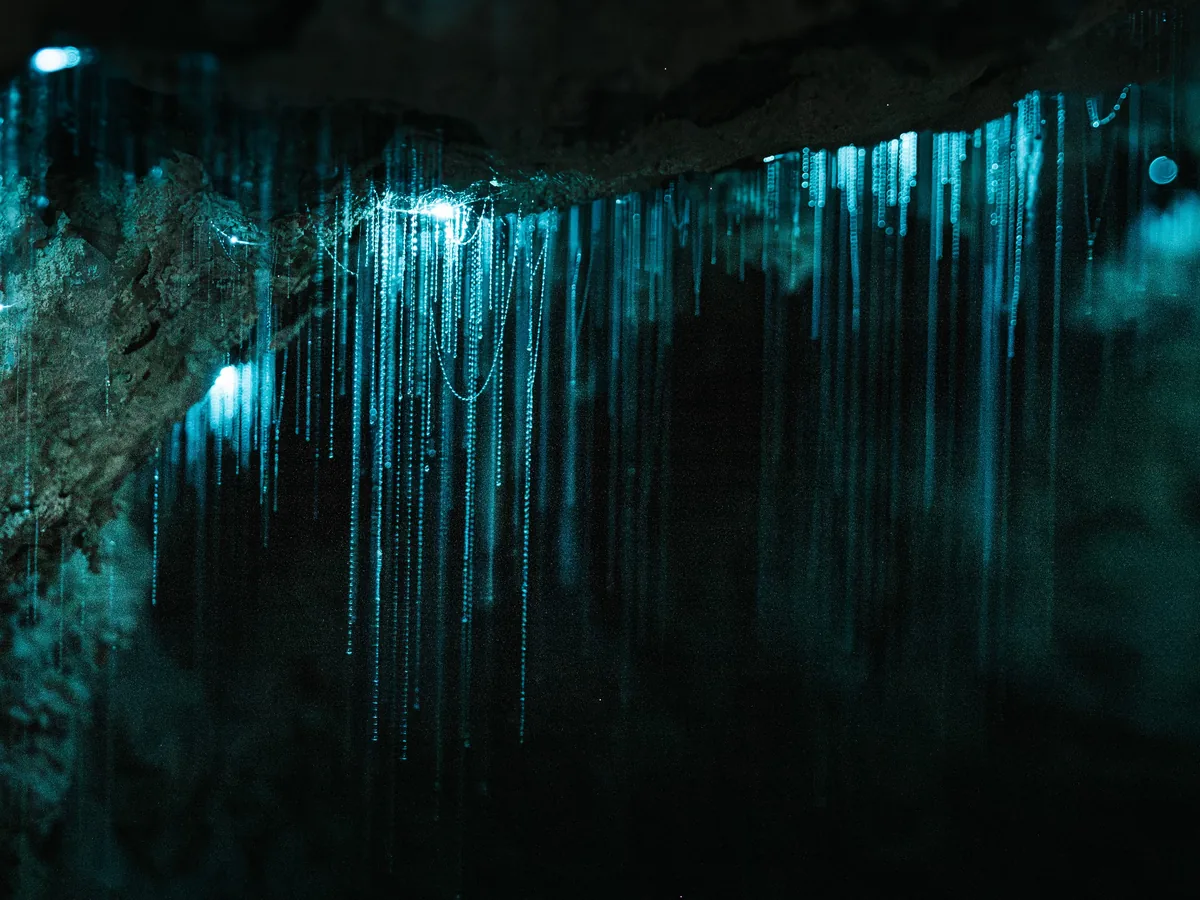
Wikipedia says the light mainly serves to attract prey. Larvae also adjust their glow to synchronise with nearby larvae, which makes the collective display more effective. The operator's article adds that hungrier larvae glow brighter, so a brighter light signals a hungrier animal. The effect on a cave ceiling is a field of small blue lights, and each is a trap. The display you see is a feeding strategy, not a signal to visitors.
The threads and the catch
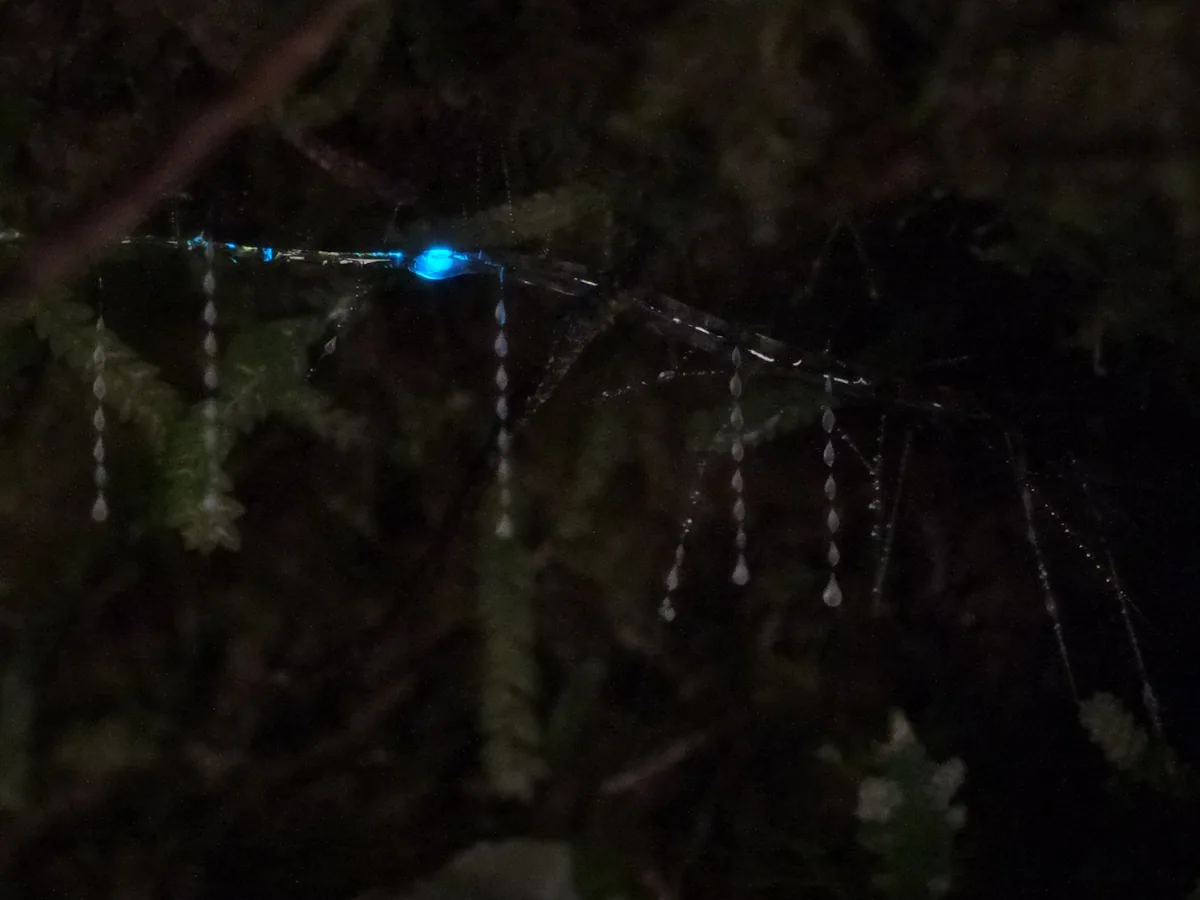
Wikipedia says the larvae are carnivorous. Each hangs up to 30 silk threads coated in sticky mucus and uses its glow to lure flying insects into them. It then reels up the prey and eats it alive. Spiders and other crawling insects are also caught, the article says. The operator's article describes a silk nest on the ceiling with dozens of mucus-beaded threads hanging below it. The photograph on this page shows those threads, which catch the light of the larva above them.
Why caves ask for darkness and silence
The operator of the Te Anau caves says photography and video filming are not permitted inside the cave, and its glowworm article says light disturbs the glowworms and disrupts their hunting behaviour. Wikipedia says the animals need shelter from air currents and a humid, dark place. Those are the reasons a guide asks you to be quiet and still, and not to shine a torch or a phone. The rule is for the animals as much as for the view.
How common are they?
Wikipedia says the total population is unknown. The species is not considered endangered, and no population decline has been observed in recent years, although some sites are managed by local conservation groups because of climate pressures. In other words, a glowworm grotto in a tour cave shows a species that is doing reasonably well, in a place that has the dark, humid conditions it needs. Wikipedia adds that populations occur in native bush as well as in caves.
Frequently asked questions
Are glowworms really worms?
No. They are the larvae of a small fly in the fungus gnat family. The adult is a delicate fly that lives only a few days.
Why do glowworms glow?
To attract prey. Wikipedia says the light mainly lures flying insects into sticky silk threads, and larvae also synchronise their glow with their neighbours.
How long does a glowworm live?
The larval stage lasts up to a year, says Wikipedia, and is the longest. Adults live only about 76 hours for females and 96 hours for males.
Sources